
blog
|Employee Experience
Building Leadership Readiness at Scale: A Development Centre Story
Published on Feb 16, 2026

4 min read

As organizations grow, leadership expectations rise and roles become more complex. Strategy can be sound, markets can be favourable, and systems can be strong, yet execution falters when leadership capability does not keep pace with business complexity.
This was the inflection point for a large, fast-growing pharmaceutical organization operating across multiple locations and functions. With increasing role complexity, expansion plans, and a diverse leadership population, the organization faced a critical question: Do we have leaders who are truly ready for the next phase of growth and do we know who they are?
Addressing this question required more than intuition or fragmented performance data. It demanded a structured, objective, and scalable approach to leadership assessment and development. This became the foundation for a comprehensive Development Centre intervention.
The Business Objective: From Talent Management to Leadership Continuity
The objective was both immediate and future-focused to build a future-ready leadership pipeline across three levels: Managers, Mid-Managers, and Senior Leadership.
The organization wanted to enable:
Succession readiness across critical roles
Ensure leadership continuity as the business grows
Identify high-potential talent objectively
Data-backed talent decisions aligned to long-term strategy
At its core, the focus was on building leadership readiness while ensuring development investments were focused, fair, and aligned with business priorities.
The Design Philosophy: Anchored in Business Reality
The Development Centre was designed to reflect the organization’s real operating environment, and role complexity.
A unified competency framework was created, integrating behavioral and functional competencies. Behavioural competencies were clearly defined across all three leadership bands, with distinct indicators for each level. In parallel, functional competencies were developed for nearly 150 unique roles, ensuring depth, relevance, and role-specific accuracy.
This framework was built and validated in close collaboration with internal subject matter experts, ensuring that the model reflected not theory, but the realities of the business.
This established a clear and trusted view of leadership capability across the organization.
Execution at Scale: Precision, Speed, and Consistency
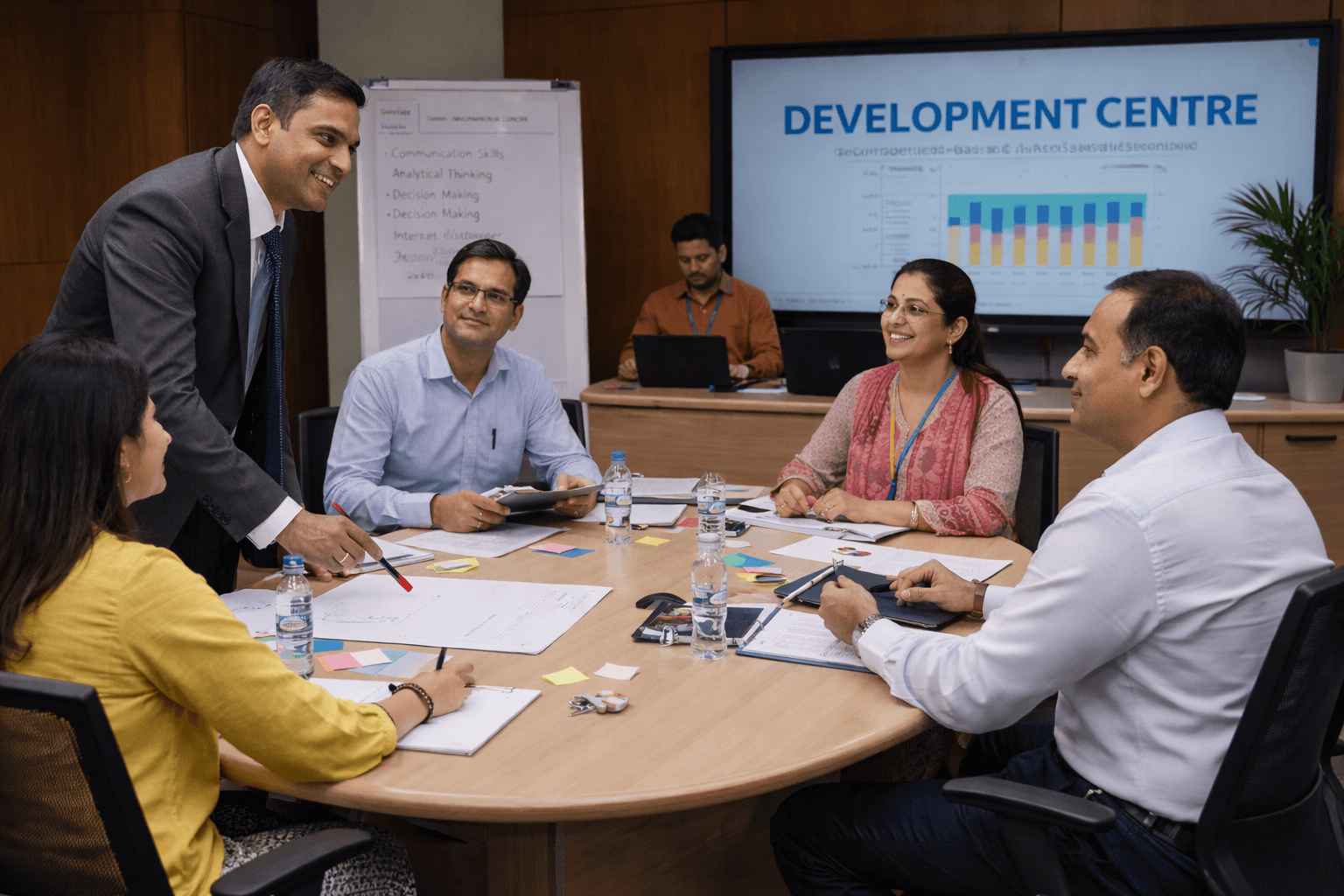
The Development Centre was executed across eight locations in India, covering over more than 600 leaders within a span of 1.5 months a scale that required strong governance and disciplined execution.
A blended assessment approach was adopted, combining virtual and in-person formats to balance reach and depth. Participants engaged in a series of carefully designed exercises, including:
Competency-based interviews
Psychometric assessments
Role plays reflecting real leadership challenges
Business case presentations aligned to role and level complexity
Each exercise was mapped directly to the competency framework, enabling consistency, objectivity, and comparability across locations and leadership levels.
Participant experience was equally important. The process emphasized transparency, fairness, and psychological safety, critical to building trust and credibility in the outcomes.
Turning Insight into Strategic Talent Decisions
Assessment is valuable only when insight leads to action.
Using a 9-Box Grid Analysis, leaders were mapped on performance and potential, providing the organization with its first enterprise-wide view of leadership capability. This was supported by detailed individual diagnostic reports and cohort-level analytics, enabling targeted development planning and strategic talent reviews.
For leaders, this brought clarity on strengths, development priorities, and readiness for future roles.
For the organization, it enabled sharper succession planning, focused development investments, and confident talent differentiation.
In practical terms, leadership discussions shifted from subjective opinions to evidence-based conversations.
Business Impact and Return on Leadership Investment
The Development Centre delivered impact well beyond assessment outcomes:
Clear visibility into leadership capability across geographies and levels
Identification of high-potential and succession-ready talent with reduced bias
Validated competency frameworks now anchoring learning journeys, development planning, and performance management
Stronger leadership bench strength and accountability for development
Most significantly, the organization now has a scalable, repeatable leadership assessment model one that supports faster, more confident talent decisions as the business evolves.
From a business lens, this translated into lower succession risk, improved leadership readiness, and higher return on leadership development investments.
Looking Ahead: Leadership as a Strategic Advantage
When designed with intent and executed with rigor, a Development Centre is not an HR initiative - it is a strategic advantage.
In an environment where growth is constant and disruption is inevitable, organizations that win are those that invest early in leadership readiness, not those that react when gaps become visible.
This engagement reinforced a powerful truth:
future-ready organizations are built by leaders who are prepared before the future arrives.
At People Business, we partner with organizations to build that readiness systematically, credibly, and at scale - so leadership becomes not a constraint to growth, but its strongest enabler.
Other Blogs





More insights